Follow my blog with Bloglovin
When I was offered the opportunity to test and write about The Big Barker Dog Bed, I knew that this was a review opportunity I would pass along to one of my trusted reviewers. The bed is meant for big dogs although good bedding is as important for all dogs, just as it is for us. The bed is the brainchild of Eric Shannon who was worried about his own dog and how many big dogs suffer from joint and hip problems. He set out to create the best possible orthopedic bed for dogs. My chosen reviewer, Linda Aronson, DVM, is a long-time breeder of Bearded Collies. She also breeds Havanese and has friends and clients with dogs of all sizes. I trust her. Here, with my thanks, is Dr. Aronson's review:
I have to admit I was excited when Darlene asked me to test
the Big Barker dog bed. I had drooled over them with our last two seniors, but
wasn’t sure I could justify the expenditure.
Compared to a human mattress of similar construction though they are a
steal, and with a 10 year guarantee you could go through a whole lot of
inferior dog beds - which really have a limited shelf life – without giving
your dog much more support than lying on the floor. On the other hand, my elderly Beardie boy really wasn’t a
fan of beds, we had to resort to a giant crate and a memory foam mattress to
stop him sleeping on the floor. My daughter’s German Shepherd liked dog beds,
but she also liked the twin sized human mattress, and the Beardie would often
join her on it. As we all know though
dogs don’t complain, and I don’t know if the human mattress really supplied the
support they needed. Sadly both of those
dogs passed before they got to try the new Big Barker bed.
Having agreed to test the bed I needed to decide on the
options. The Big Barker comes in two
styles: sleek (just the rectangular mattress),
and headrest (with a mounded pillow at one of the short ends), and three sizes:
large (48” x 30”), XL (52” x 36”), and giant (60” x 48”). They are all 7” thick, making it easier for
the dog to get off the mattress if they have physical limitations. The mattresses also come in three colors:
khaki, chocolate and burgundy. I chose
the XL headrest model in chocolate.
These mattresses are really meant for dogs weighing more than 50 lbs. They may be too firm for smaller dogs. For those you can buy the Barker Junior beds,
same colors and styles but in small (27” x 18”) or medium (33.25” x 21.25”),
both of which are 4” thick. Then again if
your dog likes firm and likes to spread out he will probably prefer the larger
models.
I eagerly awaited the arrival of my bed, and not having gone
through all the material on the company web site https://bigbarker.com/ I thought there must have been some mistake
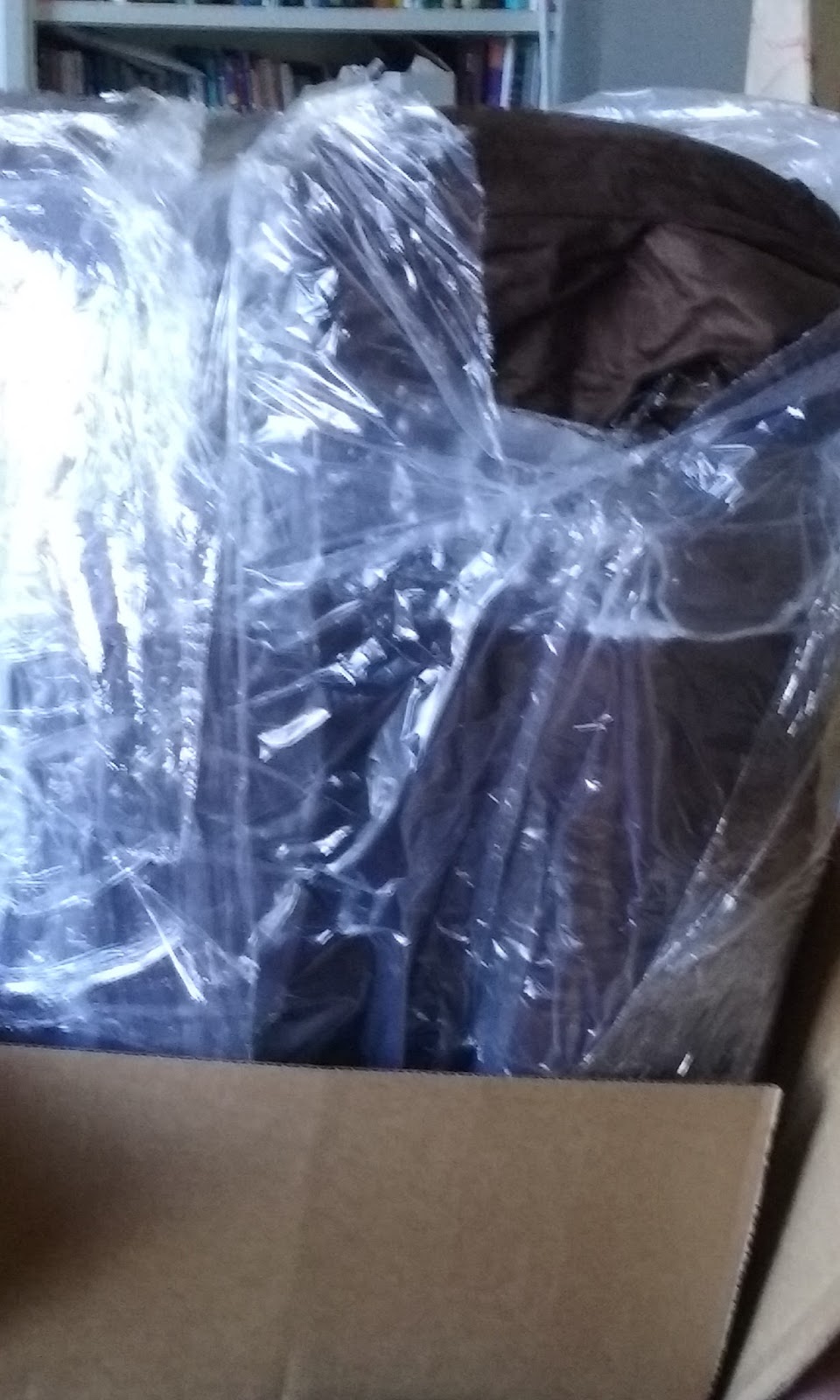
when I saw the comparatively tiny box in which it arrived. I carefully opened the box, and struggled to
extract the plastic swathed mattress. It
was rather akin to delivering a calf!
As more and more of the
plastic gave way it grew and grew and seemed to take on a life of its own. Remarkably as soon as it had emerged the bed
assumed its correct shape. It is
recommended that you let the mattress sit for 24-48 hours while the last
wrinkles ease out. I can’t say I saw a
lot of change.
Construction was fabulous;
everything is made in the USA. The
mattress is made of 3 layers of foam, a 3” layer of H45 support foam is
sandwiched between 2 layers of 2” H10 comfort foam. Meanwhile the headrest is a semicircle of
countoured foam, 4” at its gratest height. The support foam can easily support the
weight of a 300 lb dog – maybe that should be small horse - while the comfort
foam contours itself round the body adding cushioning to joints and other
pointy bits. The foam is guaranteed CertiPUR-US®,
and free of toxins – carcinogenic formaldehyde and flame retardants most
notably – as well as produced to be environmentally friendly. The cover, made of furniture grade microfiber,
has a sturdy zipper that runs round most of the two long sides and the short
side with the headrest, so that the cover is easily removed for laundering
(cold water and tumble dry on low). The cover
is moisture resistant which means that it will protect the bed from licking or
wet fur. However, I would really
recommend getting the waterproof liner.
I did not get this for testing, but it is in my estimation well worth
the extra expense. It is constructed to
perfectly fit the mattress zipping on and off.
The material is sleek and the same as that used for hospital beds, so it
won’t make a lot of noise as your dog adjusts his position, nor will it have a
bad odor that some plastics have. All
dogs sooner or later have accidents, but I think the major market for this bed
will be for older dogs many of whom may be incontinent. You can also buy replacement covers for your
bed. Some dogs are major chewers and
will attack the bed like a giant chew toy.
The cover won’t offer a great deal of protection against the jaws of a
large or giant breed dog intent on destruction.
You can request that the company provide a special order chew resistant
cover. This is made of Cordura which is
made to military standards, but much stiffer than the microfiber cover (think
back pack material). However, if your
dog is intent on destroying his bed sadly even this cover will probably succumb. If you are interested in the bed, I do
encourage you to look at the company’s website
https://bigbarker.com/ Be sure to scroll down and look at the wonderful
Tactilus sensor maps. These show you the
pressure on your poor dog’s body when he lies on one of more popular (and
inferior) dog mattresses. It’s pretty
revealing.
My son and his family arrived
for a visit right after the Big Barker arrived.
It was a perfect size for my 3 year old grandson to sleep on. Admittedly he doesn’t even weigh 30 lbs, but
over the next 10 days most of the adult humans got down on “his” bed with
him. I have to say although it was short
for us, it was every bit as comfortable as a top end human bed. He was enchanted with it. He also bounced on it a good deal and the Big
Barker took everything he could think of in stride and showed absolutely no
signs of wear!
Having read the information on my Big Barker I realized my 5
current dogs are all under the recommended 50# and up weight – the 2 Bearded
collie girls are about 44 lbs each and the Havanese between 9.5 and 11.5
lbs. So I asked a fellow vet to please
take the bed for a few days to see what her seniors, Minnie the Lab and Daisy
the corgi, thought of it. I think this
photo taken the first night at their house says it all.
To quote their owner: “This is the first time they have
willingly slept in the same bed. I can't get either of them off it.” After I collected it from them – feeling like
a wretch for doing so - this was her assessment. “The dog bed was awesome -
Minnie actually stayed out in the living room with us to lie on it instead of
going off on her own, and both dogs lay together. It was easy on and off for her with her knees (torn
anterior cruciate ligaments) and for Daisy with hip dysplasia. I would definitely consider buying a smaller
one in the future.” It looks to me like
the size is pretty perfect for the two of them, but her husband felt they just
didn’t have the room for such a big bed.
Clearly the girls strongly disagreed.
Their owner also agreed with the importance of having the waterproof
liner. Although Daisy is not close to 50
lbs the firmness of the mattress clearly didn’t worry her in the least.
Now it was time to seriously test the bed with my own
crew. Unfortunately they really aren’t
keen on beds. The Havanese quite like
the snuggle nests in the colder weather, and having found my old Beardie boy
lying on them I bought him a snuggle nest in his size with eggshell foam. It became the favorite bed in the house, they
all slept there. The orthopedic mattress
though as I said in my first paragraph was rejected unless he was forced to lie
on it. I always thought my Beardies rejected
dog beds because with their hair they became too warm and this may well be the
case. I don’t see long haired breeds in
the photos of the Big Barker, and I’ve looked through a lot of photos, but as
the company’s senior manager of customer relations, Matt Brannon points out,
the Big Barker bed is most popular with owners of Great Danes, Mastiffs and
German Shepherds. Then again they will
sleep on the leather couches and even upholstered chairs. I can get all the dogs – especially the
Havanese - to get on the Big Barker bed, but they don’t stay long, back they go
to hardwood or tile. I did posit the
question to the folks who make the Big Barker, and they explained that: “body
heat isn’t generally a problem with the Big Barker beds. It’s a problem with
memory foam, which is a “closed cell” foam. That means that there’s no air flow
within the bed, so body heat can get trapped. Big Barkers use open cell foam,
which does not have a heat retention problem like memory foam does.” So the
jury is out as to why my dogs aren’t bed fans.
Perhaps as the weather gets cooler or after I add the waterproof liner I
will find that my hairy beasties change their minds. In the meantime when the dogs’ massage
therapist comes the Big Barker is a huge hit for working on them. With the pleasant associations, I hope that
soon I will be able to report my dogs are as hooked on the Big Barker as Minnie
and Daisy. It is a wonderful bed,
especially for large or giant breed dogs that aren’t super destructive. If your dog isn’t a bed fan though, you may
need to encourage him to sleep there with the judicious use of an ex-pen and
cookies. Sometimes they just don’t know
what’s good for them; I’m looking at my older Beardie, Chaos, as I write, as she
has a problem with her shoulders from excessive jumping and hurling herself at
sliding doors. The Big Barker would be
perfect - if she’d sleep on it. Meanwhile
here is Imp enjoying a massage on the Big Barker.

Overall this is an excellent product manufactured to the
highest standards and should last a lifetime.
The designers have pretty much thought of everything, and used the
highest quality and safest materials possible.